A Better Website for Your Business: Choosing Between Custom Design and Templates

A Better Website for Your Business: Choosing Between Custom Design and Templates
A website is a business's first impression on its potential customers for most businesses. It represents your brand, communicates your services, and creates an impression that can result in a sale. But when it comes to website construction, one thing is sure: should you use a custom-designed website or pick a pre-designed design? Understanding custom website design vs template website options can help you make the right decision. While both have their pros, the best one for you will depend on your business objectives, budget, and future needs.
What Is Custom Website Design?
So, if you're looking for a custom website design, you must know what it entails.
Custom website design involves building a website that fits the requirements, tastes, and brand identity of a business. Everything from the layout, navigation, colours, and typography to functionality is designed to present a unique experience.
One of the primary advantages of custom websites is their flexibility. Specific features, custom user journeys, and layouts that reflect a business's marketing goals can be included. Another benefit of custom websites is that they are easily scalable, supporting the expansion of businesses and the addition of new services, features, or integrations.
Furthermore, a custom website can help to build trust and distinguish a company from its competitors.
What Is a Template Website?
A template website is a pre-designed website that can be customized with specific content, images, colours, and branding for a business. There are many templates for different industries and business types available on website builders and content management systems.
The main advantage of templates is that they're inexpensive. The basic design and structure are already there, so businesses can build their sites without having to invest a ton of money into design and structure.
Templates also speed up the website-building process. They are particularly useful for companies that struggle to build their web presence, including startups, small businesses, freelancers, and those who don't need any fancy functionality.
However, for some, you may find that there are limitations on the amount of customization they can do with the template. Also, if other websites have the same page layout, it could be difficult for businesses to make their websites look unique.
Key Differences Between Custom and Template Websites
Custom and template websites are different in several aspects.
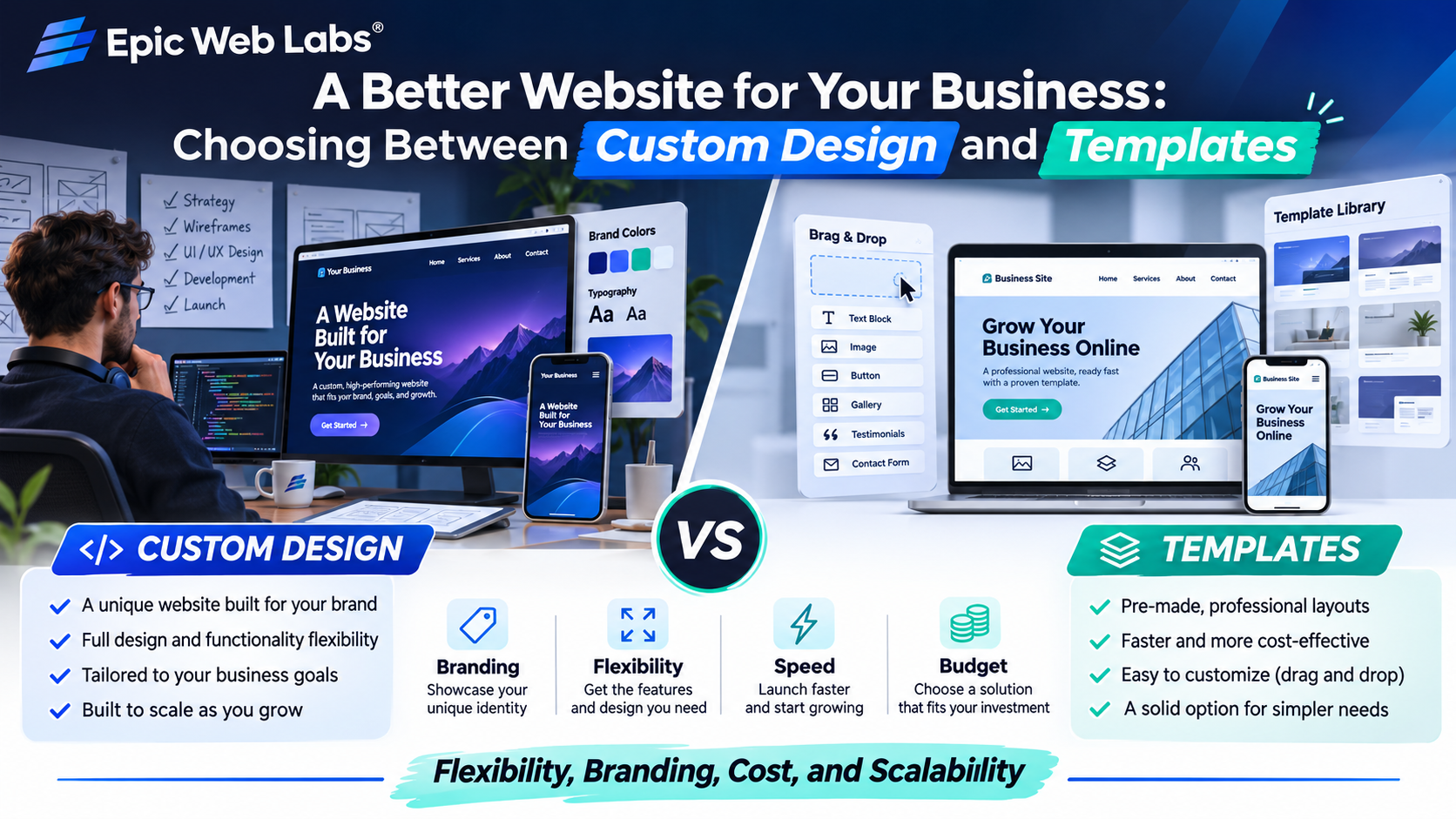
The main differences are flexibility, cost, development time, and scalability.
The advantage of custom websites is that they have a higher initial price and take longer to create. They do, however, offer more control over the design and functionality. Template sites are usually more affordable and quicker to establish, but they can have fewer customization options.
It's also essential to develop a website with performance and search engine optimization (SEO) in mind. Building your own website from scratch allows it to be optimized to serve your business needs, while a poorly configured template can be too full of features and design elements that hinder performance.
Having either of these does not necessarily translate into improved SEO. The main factors that matter are site structure, loading speeds, mobile responsiveness, content quality, and technical optimization.
What Should Businesses Choose?
The choice will be based on the aims of your site. A template website is an effective alternative for a new business, testing a new idea, or working with budget constraints.
However, for mature companies, brands, and businesses with specific needs, custom development might be more suitable. It enables them to build a website that will help with their operations, marketing plans, and future growth.
Final Thoughts
When considering business goals and costs, there's a balance between custom websites and template websites. There are pros and cons to both. Templates are convenient and cost-effective, while custom development is flexible, original, and can be expanded. Carefully review your needs and select a strategy that helps you build your brand and provides a positive experience for visitors.A website is a business's first impression on its potential customers for most businesses. It represents your brand, communicates your services, and creates an impression that can result in a sale. But when it comes to website construction, one thing is sure: should you use a custom-designed website or pick a pre-designed design? Understanding custom website design vs template website options can help you make the right decision. While both have their pros, the best one for you will depend on your business objectives, budget, and future needs.
What Is Custom Website Design?
So, if you're looking for a custom website design, you must know what it entails.
Custom website design involves building a website that fits the requirements, tastes, and brand identity of a business. Everything from the layout, navigation, colours, and typography to functionality is designed to present a unique experience.
One of the primary advantages of custom websites is their flexibility. Specific features, custom user journeys, and layouts that reflect a business's marketing goals can be included. Another benefit of custom websites is that they are easily scalable, supporting the expansion of businesses and the addition of new services, features, or integrations.
Furthermore, a custom website can help to build trust and distinguish a company from its competitors.
What Is a Template Website?
A template website is a pre-designed website that can be customized with specific content, images, colours, and branding for a business. There are many templates for different industries and business types available on website builders and content management systems.
The main advantage of templates is that they're inexpensive. The basic design and structure are already there, so businesses can build their sites without having to invest a ton of money into design and structure.
Templates also speed up the website-building process. They are particularly useful for companies that struggle to build their web presence, including startups, small businesses, freelancers, and those who don't need any fancy functionality.
However, for some, you may find that there are limitations on the amount of customization they can do with the template. Also, if other websites have the same page layout, it could be difficult for businesses to make their websites look unique.
Key Differences Between Custom and Template Websites
Custom and template websites are different in several aspects.
The main differences are flexibility, cost, development time, and scalability.
The advantage of custom websites is that they have a higher initial price and take longer to create. They do, however, offer more control over the design and functionality. Template sites are usually more affordable and quicker to establish, but they can have fewer customization options.
It's also essential to develop a website with performance and search engine optimization (SEO) in mind. Building your own website from scratch allows it to be optimized to serve your business needs, while a poorly configured template can be too full of features and design elements that hinder performance.
Having either of these does not necessarily translate into improved SEO. The main factors that matter are site structure, loading speeds, mobile responsiveness, content quality, and technical optimization.
What Should Businesses Choose?
The choice will be based on the aims of your site. A template website is an effective alternative for a new business, testing a new idea, or working with budget constraints.
However, for mature companies, brands, and businesses with specific needs, custom development might be more suitable. It enables them to build a website that will help with their operations, marketing plans, and future growth.
Final Thoughts
When considering business goals and costs, there's a balance between custom websites and template websites. There are pros and cons to both. Templates are convenient and cost-effective, while custom development is flexible, original, and can be expanded. Carefully review your needs and select a strategy that helps you build your brand and provides a positive experience for visitors.